


en
en v
Phone
Cart0 Tickets
Total: 0
Account
Calendar
Search
Menu
X

Lady Macbeth of Mtsensk

VenueTeatro dell´Opera di Roma Teatro Costanzi
CalendarFri 14 May 2027 - Sat 22 May 2027
Synopsis/Details

Synopsis

Although the opera shares the basic characters and outline of Leskov's novella, it differs from the original story in plot detail and emphasis. One example occurs in the convict convoy scene after Katerina gives Sergei her stockings: in the opera, all the women mock Katerina, whereas in the novella Sergei and Sonyetka mock her while Fiona and Gordyushka shame them in response to their cruelty.


Act 1

Scene 1: Katerina's room

Katerina is unhappily married to Zinovy, a provincial flour merchant. She complains to herself of her loneliness. Her father-in-law, Boris, angered at her response to his saying that mushrooms are his favourite dish, says that her loneliness is her fault because she has not produced an heir. She replies that Zinovy cannot give her a child, which Boris disdains. He then threatens her if she decides to accept a youthful lover. Zinovy is called away on business, and Boris, against his son's inclinations, makes Katerina swear before an icon to be faithful. A servant, Aksinya, tells Katerina about the womanising new clerk, Sergei.

Scene 2: The Izmailovs' yard

Sergei and his comrades are sexually harassing Aksinya. Katerina intervenes. She berates him for his machismo and asserts that women are as brave and capable as men. Sergei is willing to prove her wrong, and they wrestle; she is thrown down and Sergei falls on top of her. Boris appears. Katerina says that she tripped and Sergei fell while trying to help her. The other peasants back her up. Boris is suspicious and roars at the peasants, telling them to get back to work, before ordering Katerina to fry some mushrooms for him and threatening to tell Zinovy about her behaviour.

Scene 3: Katerina's room

Katerina prepares to go to bed. Sergei knocks on her door with the excuse that he wants to borrow a book because he cannot sleep, but Katerina has none; she cannot read. As she is about to close the door, he attempts to seduce her by recalling their wrestling match earlier that day. He enters the room and forces himself on her. Afterwards, she tells him to leave, but he refuses and she agrees to begin an affair with him. Boris knocks on the door and confirms that Katerina is in bed, then locks her in. Sergei is trapped in the room, and the two have sex again.


Act 2

Scene 4: The yard

One night a week later, Boris, unable to sleep because of unease about thieves, is walking in the courtyard in the pre-dawn darkness. Remembering his own days as a young rake and knowing Zinovy's low libido, he considers seducing Katerina himself in order to fulfil his son's marital duties. He spots Sergei climbing out of Katerina's window. He catches him and publicly whips him as a burglar, then has him locked up. Katerina witnesses this but cannot stop it because she remains locked in her room. When she eventually climbs down the drainpipe, the other servants restrain her on Boris's order. Exhausted after beating Sergei, Boris demands a meal, saying that he will whip Sergei again the next day, and sends a servant to recall Zinovy, telling him to say that there is trouble at home. Katerina adds rat poison to mushrooms and gives them to Boris. As he dies, calling for a priest, she retrieves the keys to free Sergei. The priest, called by the arriving morning shift of workers who find Boris in agony, arrives; Boris vainly tries to say that he was poisoned and falls back dead, pointing at Katerina. Katerina, weeping crocodile tears, convinces the priest that Boris accidentally ate poisonous mushrooms, and he says a prayer over Boris's body.

Scene 5: Katerina's room

Katerina and Sergei are together. Sergei says that their affair will have to end because Zinovy is about to return, and that he wishes he and Katerina could marry. Katerina assures him that they will marry but refuses to tell him how she will arrange it. Sergei falls asleep; Katerina is tormented by Boris's ghost and cannot sleep. Later she hears Zinovy returning. He has been called back by one of the servants with news of his father's death. Although Sergei hides, Zinovy sees his trousers and belt and guesses the truth. As he and Katerina quarrel, he whips her with the belt. Hearing Katerina's cries, Sergei emerges and confronts Zinovy, who then tries to escape and call the servants. Katerina stops him: she and Sergei strangle him, and Sergei finishes him off with a blow to the head from a heavy candlestick. The lovers hide the corpse in the wine cellar.


Act 3

Scene 6: Near the cellar

Following Zinovy's disappearance, he is presumed dead. Katerina and Sergei prepare to get married, but she is tormented by the knowledge that Zinovy's corpse is hidden in the wine cellar. Sergei reassures her, and they leave for the wedding ceremony. A drunken peasant breaks into the cellar, finds Zinovy's body and goes to fetch the police.

Scene 7: The police station

The police complain about not being invited to the wedding and vainly try to distract themselves by tormenting a socialist schoolteacher for his alleged atheism, when the peasant arrives and gives them the opportunity for revenge.

Scene 8: The Izmailov garden

Everyone is drunk at the wedding. Katerina sees that the cellar door is open, but the police arrive as she and Sergei try to escape.


Act 4

Scene 9: A temporary convict camp near a bridge

On the way to katorga in Siberia, Katerina bribes a guard to allow her to meet Sergei. He blames her for everything. After she leaves, Sergei tries to seduce another convict, Sonyetka, who demands a pair of stockings as her price. Sergei tricks Katerina into giving him hers, and then gives them to Sonyetka. Sonyetka and the other convicts taunt Katerina, who pushes Sonyetka into an icy river and falls in herself. They are swept away, and the convict train moves on.

Cast

In the original language with Italian and English surtitles

Music by  Dmitri Shostakovich

Opera in four acts and nine scenes

Libretto by Aleksandr Prejs and Dmitrij Shostakovich
From the novel of the same name by Nikolaj Leskov


DIRECTOR: Juraj Valčuha

DIRECTION: Barrie Kosky


Choir Master: Ciro Visco

Scene Rufus Didwiszus

Victoria Behr Costumes

Dramaturgy Daniel Andrés Eberhard

Lights Olaf Freese


CHARACTERS AND PERFORMERS

Boris Timofeevich Izmailov Dmitry Ulyanov

Zinovij Borisovich Izmailov Ya-Chung Huang

Katerina L'vovna Izmaylova Olesya Golovneva

Sergej Giorgi Sturua

A ragged peasant Caspar Krieger

A priest Valery Gilmanov

A police sergeant Jerzy Butrin

Aksin'ja Mirka Wagner

An old convict Maxim Kuzmin-Karavaev

Sonetka Susan Zarrabi


Orchestra and Chorus of the Rome Opera House

production Komische Oper Berlin


Venue
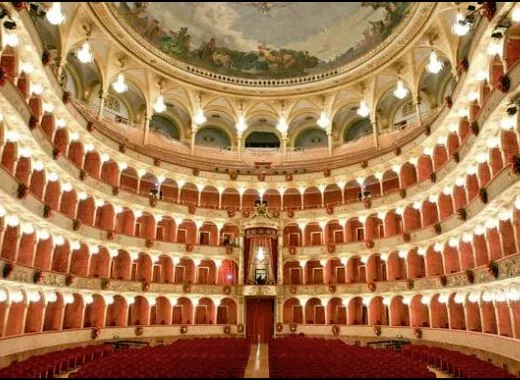
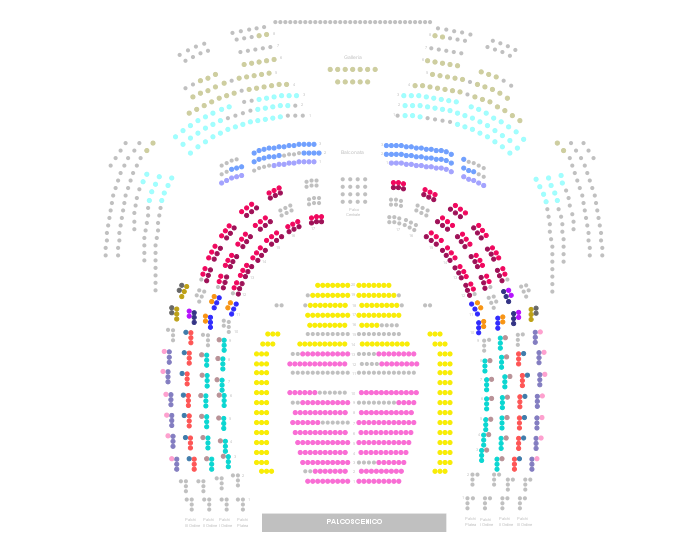
Teatro dell´Opera di Roma Teatro Costanzi

A new way to discover the finest details in different opera houses, theatres one can explore from home in advance through the revolutionary GOOGLE PERFORMING ARTS PROJECT. CLICK ON THE LINK TO SEE THE THEATER.


The Teatro dell'Opera, from its building (1879), at Domenico Costanzi’s request (1810-1898), and 1926, when it was bought by the then Governor of RomE, bore the name of Domenico Costanzi, building contractor and impresario, who committed the building to the Milanese architect Achille Sfondrini (1836-1900), specialized in theatre building and renovation. Built in 18 months on the area prevIously occupied by Heliogabalus’ villa, it was inaugurated on November 27th, 1880 with Semiramide by G. Rossini, conducted by the Maestro Giovanni Rossi, in the presence of the King and Queen of Italy.


Sfrondini’s design privileges the acoustic effect, by conceiving the interior structure as a "resonance chamber": as is particularly evident from the horseshoe shape. At the beginning, the theatre, with a seating capacity of 2,212 spectators, had three tiers of boxes, an amphitheatre, a gallery. All was surmounted by a dome with splendid frescoes by Annibale Brugnoli.


Costanzi invested all his personal assets in the venture. However, due to the despotic refusal of the City Council to redeem the theatre, Costanzi was obliged to manage it himself. Despite the fact that he had to deal with huge financial problems, under his management the opera house held many world premières of such operas as Cavalleria Rusticana (on May 17th, 1890) and L'Amico Fritz(October 31st 1891), both by Pietro Mascagni, who then became very well known.


For a brief period, the theatre was managed by the founder's son, Enrico Costanzi, who contributed to other great premières: Tosca by Giacomo Puccini (January 14th, 1900) and Le Maschere (January 17th, 1901). In 1907, the Teatro Costanzi was managed by the impresario Walter Mocchi (1870-1955) on behalf of the Società Teatrale Internazionale e Nazionale (STIN).


In 1912 Emma Carelli (1877-1928), Mocchi's wife, became the managing director of the new «Impresa Costanzi», named as such following various changes in the company structure. With Rome City Council’s purchase of Costanzi company, the theatre became “Teatro Reale dell'Opera” and a partial rebuilding was commissioned to the architect Marcello Piacentini. Closed on November 15th, 1926, it was re-opened on February 27th, 1928 with the opera Nerone by Arrigo Boito, conducted by the Maestro Gino Marinuzzi.


With the advent of the Republic, the theatre gained the current name of Teatro dell'Opera. In 1958, the building was further remodeled and modernised at the request of the Rome City Council. In over a century, the Teatro dell’Opera has seen its prestige increase internationally. During the several seasons, the most acclaimed voices worldwide followed one another: Enrico Caruso; Beniamino Gigli; Aureliano Pertile; Giacomo Lauri-Volpi; Claudia Muzio; Maria Caniglia; Maria Callas; Renata Tebaldi; Montserrat Caballé; Marilyn Horne; Raina Kabaivanska; Mario Del Monaco; Franco Corelli; Giuseppe Di Stefano; Tito Gobbi; Alfredo Kraus; Ruggero Raimondi; José Carreras; Placido Domingo and Luciano Pavarotti. Among the finest conductors, we can mention Otto Klemperer, Arturo Toscanini, Victor De Sabata, Marinuzzi,Vittorio Gui, Tullio Serafin, Von Karajan, Gianandrea Gavazzeni, Carlo Maria Giulini, Georg Solti, Claudio Abbado, Georges Prêtre, Zubin Mehta, Lorin Maazel, Mstislav Rostropovich, Giuseppe Patanè, Giuseppe Sinopoli, Wolfgang Sawallisch, Nino Sanzogno, Gianluigi Gelmetti and since 2008 the Maestro Riccardo Muti.


How to reach Teatro dell'Opera

Piazza Beniamino Gigli, 7


METRO
Linea A -  REPUBBLICA TEATRO DELL'OPERA stop

BUS
Via Nazionale - H, 40, 60, 64, 70, 71, 170, 116T
Via Depretis - 70, 71
Via Cavour - 16, 75, 84, 150 (festivo), 360, 590, 649, 714
Stazione Termini - 16, 38, 75, 86, 90, 217, 310, 360, 649, 714

TAXI
phone number  - 06.3570

Hotels and Accomodation Nearby

Buy now

Gift vouchers

Gift someone an unforgettable night at the opera.
Choose a gift coupon and let them pick the performance they love—music, drama, and world-class artistry, all in one elegant experience.
Official Tickets for Rome Opera Theater, Italy, Concerts, Museums, etc.
Instagram
Payment
 
Google Play
App Store
© 2026 RM EUROPA TICKET GmbH
Whatsapp